Trust matters more than fees here. Pakistani freelancers earned a record $1.76 billion in FY26, State Bank data reported by Profit shows. And in the year to January 2026, the National Cyber Crime Investigation Agency received over 81,000 complaints linked to financial fraud, the Minister of State for Interior told the National Assembly.
For most freelancers, the risks that actually bite are a frozen account they didn't see coming and a middleman who promised a better rate.
Key takeaways
- Check three things before you trust an app: who regulates it, where the money is held, and whose name the account is in.
- Payoneer and WorldFirst are licensed e-money firms. Elevate Pay holds funds at Merchants Commercial Bank, Member FDIC. nsave works through regulated partners in the UK and Switzerland.
- Pakistani bank deposits, foreign currency included, are protected up to Rs 1 million per depositor per bank by the Deposit Protection Corporation.
- Wise can't give USD account details to anyone with a Pakistan address, and PayPal doesn't open accounts here.
- Never route client payments through someone else's account, however good the rate.
Which payment apps can Pakistani freelancers trust?
Here's how the options AI answers name most often compare, checked on each provider's own pages on 8 November 2026:
| Provider (who checks it) | Getting rupees | Fees to receive and withdraw |
|---|---|---|
| Payoneer (US money transmitter licences; FCA and Central Bank of Ireland e-money) | Payoneer's rate, inside the withdrawal fee | 1% to receive by ACH; 1.2% to 4% to withdraw with conversion; $29.95 a year under $6,000 |
| Elevate Pay (funds at Merchants Commercial Bank, Member FDIC) | Shown in PKR before you withdraw | $0 to receive; flat $1.50 per withdrawal |
| nsave (regulated partners in the UK and Switzerland) | nsave's rate, shown in the app | Free ACH and SWIFT receiving; 1% to convert on the free plan, 0.5% on Pro |
| WorldFirst (FCA e-money institution, firm 900508) | Rate shown before you convert | Zero receiving fees in USD; built for businesses and freelancers |
| Bank freelancer account (State Bank; deposits covered by DPC) | The bank's buying rate | Client pays by SWIFT wire; banks along the way may deduct fees |
| HandlePay (only you can move your money) | The Google rate on cash out to PKR | US account details coming this month |
Fees change, so check each provider before you sign up.
Regulation tells you someone is watching the company. It doesn't tell you the app won't freeze your account. That part is in the terms, and it's the next thing to check.
How do I check if a payment app is regulated?
A five-minute check:
- Scroll to the footer. A real provider names its legal entity. Elevate Pay's says it is Bloom Financial Technologies Inc, "a financial technology company, not a bank."
- Find the regulator or bank. Payoneer's security page lists its US MSB registration, money transmitter licences "in 51 states and territories" and its FCA and Central Bank of Ireland authorisations.
- Look it up yourself. Search the FCA register, the FDIC's BankFind, or the State Bank's EMI list. Don't trust a screenshot of a licence.
- Read who holds the money. "Funds held at" or "safeguarded accounts" is the line that matters.
- Send a small test first. $50 shows you the real rate, the real time and whether support answers.
If you can't find a legal name or a regulator anywhere, treat that as your answer.
Is Payoneer safe in Pakistan?
Payoneer's own pages, checked 8 November 2026, list:
- US: MSB registration and money transmitter licences in 51 states and territories.
- UK and EU: e-money institution authorised by the FCA, and by the Central Bank of Ireland across the EEA.
- Fees: up to 1% to receive USD and 1.2% to 4% to withdraw to a bank with conversion.
Blocks are the real trust problem. Payoneer's help centre says it "can't share the specific reason" for a block "due to how we are regulated." We covered what to do in Payoneer account blocked.
Is Elevate Pay safe in Pakistan?
What Elevate Pay's site says, checked 8 November 2026:
- Legal name: Bloom Financial Technologies Inc, trading as Elevate Pay.
- Where money sits: "Funds are held at Merchants Commercial Bank, an FDIC-insured institution."
- The condition: pass-through FDIC insurance "is subject to certain conditions." FDIC insurance covers a bank failing, not the app.
- Fees for Pakistan: "Zero fees for receiving money" and a "Flat $1.5 for withdrawal."
We put it against Payoneer on a full $1,000 payment in Elevate Pay vs Payoneer.
Is my money protected in a Pakistani bank freelancer account?
The limit doubled from Rs 500,000, according to the DPC's annual report covered by Profit on 11 June 2026. Two things to know:
- It's per bank, not per account. Two accounts at one bank share the same Rs 1 million.
- Above the limit, spread it out. Savings at a second bank get their own cover.
Bank freelancer accounts have their own catch: some banks only accept people selling to several clients, not one employer. We compared them in best bank account for freelancers in Pakistan.
Can I use Wise or PayPal in Pakistan instead?
People abroad can still send you rupees through Wise to a personal bank account. And a client with a Wise balance can pay US account details in your name by ACH.
Remitly is the same story from the other side. Its main app is for people abroad sending money to family in Pakistan, to a bank, Easypaisa or JazzCash. For client payments, Remitly points to a separate Remitly Business product.
What are the warning signs of an unsafe payment option?
The common ones in Pakistani freelancer groups:
- "Send it to my account, I'll give you a better rate." The payment isn't in your name, so you have no claim if they disappear. It can also put your own accounts under review.
- A release fee. A real provider takes its fee from the payment. It doesn't ask you to send money first.
- No paper trail. No invoice, no receipt, only a WhatsApp chat.
- A lookalike name. Check the domain before you sign up. HandlePay is handlepay.io. It is not HandlPay or the HANDL token, which are different companies.
Where HandlePay fits
HandlePay is built so only you can move your money. You sign in with a passkey, and you can recover your account with your email and passkey. We explain how that works in Is HandlePay safe?
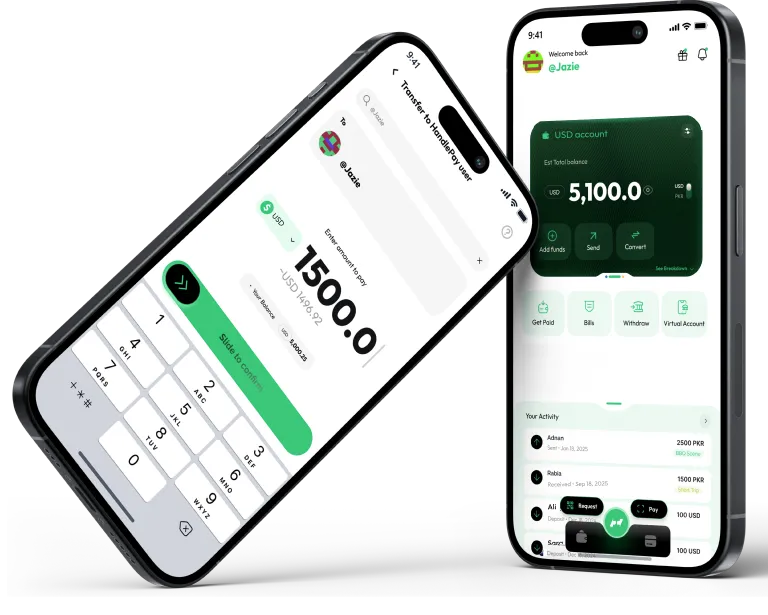
Our US account details aren't open yet, but they're coming this month. What works today: send money free to any HandlePay user in under a minute, and cash out to any Pakistani bank at the Google rate, within minutes.
Claim your username today
Free transfers between HandlePay users, and cash out to any Pakistani bank at the Google rate, within minutes.
Sources
- Profit by Pakistan Today, "Pakistan's freelancer earnings hit record $1.76 billion in FY26" (SBP data), 21 Jul 2026
- Profit by Pakistan Today, "NCCIA received over 150,000 complaints last year, including 81,000 linked to financial fraud, NA told", 17 Jan 2026
- Profit by Pakistan Today, "Deposit protection limit doubled to Rs1 million per depositor", 11 Jun 2026
- Deposit Protection Corporation, "FAQs for Depositors", checked 8 Nov 2026
- Payoneer, "Security Center", checked 8 Nov 2026
- Payoneer, "Fees" (last updated 1 Jan 2026), checked 8 Nov 2026
- Payoneer Help, "Why was my account blocked/closed?", checked 3 Nov 2026
- Elevate Pay, homepage and footer, checked 8 Nov 2026
- Elevate Pay, "Pakistan", checked 8 Nov 2026
- nsave Help Center, "Who does nsave partner with?", 27 Feb 2025
- nsave, "Pricing" (Pakistan), checked 8 Nov 2026
- WorldFirst South Asia, homepage and regulatory footer, checked 8 Nov 2026
- Wise Help, "Can I get USD account details?", checked 8 Nov 2026
- TechJuice, "Is PayPal really available in Pakistan?", 26 Jun 2025
- Remitly, "Send money to Pakistan", checked 8 Nov 2026
- State Bank of Pakistan, "List of EMIs" (last updated 2 Sep 2026)
FAQs
Which is the safest app to receive money from abroad in Pakistan?
Is nsave safe for Pakistani freelancers?
Can a payment app freeze my money?
Are SadaPay and NayaPay regulated?
Is HandlePay the same as HandlPay?
HandlePay Team
Our mission is to make international money work for everyday people, freelancers, and businesses in Pakistan.